A Competence Framework for Embedding Race and Culture 2.0
A practical approach to race and multicultural competence.
DOWNLOAD: Please note the LATEST competency framework with video lessons and CPD Certificate has been moved to our e-learning portal. Click here to access here
ABSTRACT: A practical competency framework is presented for race and cultural competence based on evolving (2.0) continuum of competencies needed to support clients with range of racial-cultural group categorisations, including based on phenotype, heritage, ethnic identities. This competency was developed through synthesis of existing multicultural competencies, race (phenotype) based racism experiences, expertise, theories and tried and tested training delivery method over 14 months.
KEY WORDS: race, racism, antidiscrimination, antioppression, competence, multicultural, decolonizing, culture, ethnicity, trauma, racial trauma.
ma@paththerapy.co.uk
For all counsellors, psychotherapists, psychologists, psychiatrists, and mental health practitioners including therapist, trainers, curriculum planners, researchers and supervisors.
Defining Race and culture 2.0
Race and culture 2.0 is an all-inclusive model of practice which considers the psychological impact on clients, as well as their experiences and strengths, in relation to their racial-cultural group assignments and meanings, whether by society, birth, geolocation, or self.
Racial-cultural groupings may exist along intersections of phenotype, heritage, and cultural group(s) such as ethnicity, language, citizenship status, nationality, migration history, homeland, common intergenerational and collective history, ultimate beliefs such as faith, and worldviews. While psychological impact is often in relation to the client’s racial-cultural positionality within a western cultured society (similar/different), it is also inclusive of a multitude of relationships within and between racial-cultural groups, e.g., Black to White, White to White, Catholic to Protestant, South Asian to East Asian, multiracial to Black, Roma to White, etc. Therefore, to be explicit, considering the effects of a White client’s identity within a western or another cultural context is part of this inclusive practice.
Further, the inclusive model of practice allows us to consider the impact on clients, as well as the conflicts, experiences, and strengths of clients belonging to or interacting within embedded cultural group(s) (ECG) within society. Examples include family, profession, LGBTQIA+ community, social groups, faith groups, as well as micro and macro systems such as education, mental health, political systems, and healthcare.
Competency Principles
There are eight guiding principles for working with aspects of race and culture.
Developing an Anti-Discrimination Practice
This competence requires the development of an antidiscrimination action and skills in recognising and improving services, whether within the self as a ‘practice of one’ or an organisation / agency. Broadly, these skills relate to identifying improvements to access, experience, service quality, and outcomes for Majority Diverse clients or for any other disadvantaged groups or individuals.
Embed as Standard Into Practice
Race and culture 2.0 must be seamlessly embedded into the therapist’s approach (not as an add-on), including assessing, conceptualising, and working therapeutically with all clients regardless of their racial-cultural grouping(s). Furthermore, this understanding provides further opportunities for reflexive practice in considering how theories, research, curriculum, and our approaches are influenced by the cultural context(s) within which they have evolved.
Salience of Phenotype (including skin tone)
The clients’ phenotype and its intersection with communication approach such as language, dialect, tone and observable expression must be actively considered. Considerations include the therapist’s own colour such as white, race process, impediments within the relationship, as well as clients experience within the world. Therapists need to mindful of race avoidance such as viewing clients experience solely in relation to clients’ cultural contexts and worldview.
Working on Your Own Racial-Cultural Identity
This competence requires therapists, trainers, supervisors, and researchers to work on their own racial-cultural identity in consideration of the high-level aims outlined above, paying particular attention to the power dynamics in society, the profession, and between themselves and their clients. Further, this allows for the first-hand experience of a racial-cultural development process, which could be relevant to clients.
Affirming Racial-Cultural Groups
The therapist affirms the similar/different racial-cultural group identities of the client. Therapists need to be aware of the magnitude of their responsibility in working with clients of similar/different racial-cultural groups, including those who experience the loss of heritage such as with transracial adoptees. Therapists need to ensure they work in an anti-superiority and anti-assimilative way with clients from similar/different racial-cultural groups in order to preserve and affirm their identified heritage.
Racial-Cultural humility
Therapist’s need be reflexive in how they view clients from and with similar/different groups and worldviews, ensuring they see the uniqueness of the client rather than relying on external sources of knowledge. Therapists see difference, shared humanity, and uniqueness.
Responsibility for Reaching Clients
While the matter of whether the client will feel you can help them is a complex and multi-factored issue, it is vital that the therapist be open to continuously self-reflect on their ability. Furthermore, they must be critical of the nature of their service to ‘reach’ clients rather than making implicit judgements or stereotypes associated with various racial-cultural groups, such assuming certain racial-cultural groups just do not come to therapy. Ask what improvements are needed in your own practice?
Ongoing Practice
Therapists must obtain supervision from a qualified therapist who has undertaken the decision to follow this or equivalent competence standards, as well as committed themself to an anti-discrimination ethos. Therapists need to continue their development of race and culture while recognising this as a lifelong process. It is particularly important that this development includes experiential activities such as group encounters or gaining lived experience within various racial-cultural groups.
How to Use
This framework may be used as input to reflect on your own competence and plan your training and self-development. It is suitable for training organisations, curriculum designers and CPD organisers in assessing gaps in learning. It is not a substitute for training. In addition, this is not a complete framework for transpersonal, religious, and spirituality competence, but rather a starting point for integrating clients’ worldviews and methods of healing into practice in an affirming anti-discriminatory manner.
Any feedback or requests for change: email: admin@tadf.co.uk (or tadf.co.uk)
Structure
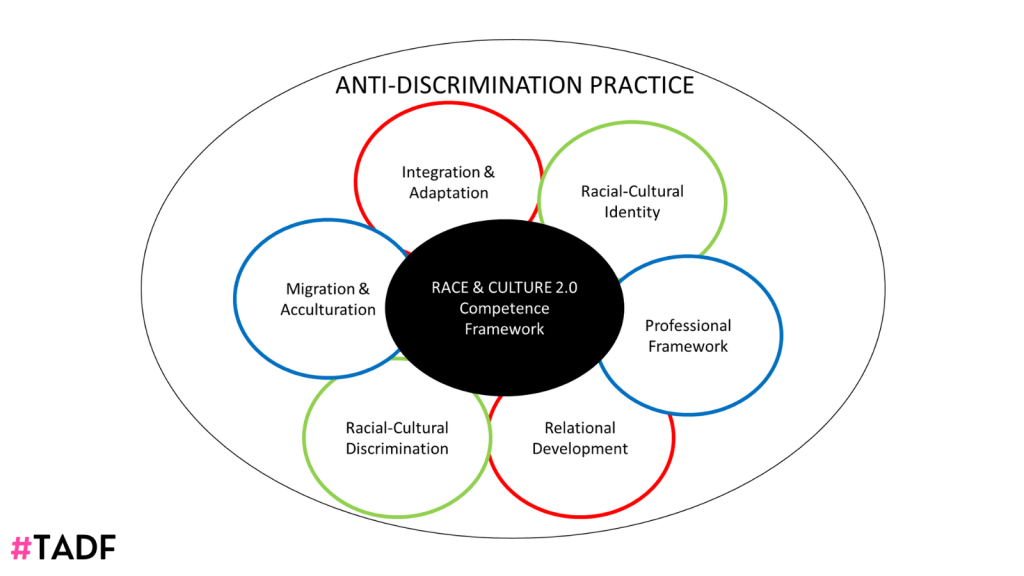
This framework, for convenience, focuses on eight interrelated themes.
- Professional and ethical framework
- Relationship development
- Racial-cultural discrimination
- Racial-cultural identity development
- Integrating and adapting therapy
- Migration and acculturation
- Anti-discrimination practice
- Knowledge and self-awareness

 The Wholeness Solution for Training, Curricula & Practice