
The Seven-Eyed Model of supervision has long been regarded as one of the most influential integrative supervision models in counselling and psychotherapy. Originating from the work of Peter Hawkins and Robin Shohet (2012), the model expanded supervisory thinking beyond simple case management by attending to multiple relational dimensions: client, practitioner, supervisor, process, and wider organisational context.
Its enduring value lies in recognising that supervision is never simply about technique. It is relational, systemic, reflective, and contextual.
Yet despite its strengths, the model also reflects the assumptions of the professional cultures and historical moment from which it emerged. As supervision theory evolves in response to wholeness and readiness for universal design (Ahmad, 2026), anti-oppressive practice, intersectionality, decolonial critique, disability justice, queer theory, and collective understandings of care, important limitations within the traditional Seven-Eyed framework become increasingly visible.
The issue is not that the model is wrong. The issue is that critical dimensions of relationality, power, communication, and social location remain peripheral rather than foundational, and new dimension of relating including communication and meaning (Ahmad, 2026) missing in consideration.
This is precisely where the Wholeness Solutions WICKET-BOND framework becomes evaluative and thus transformative.
The Limits of “Eye 7” and Peripheral Context
The Seven-Eyed Model attempts to account for organisational and cultural context through “Eye 7,” which explores the wider system surrounding the work. While significant for its time, contextual understanding is treated as an additional layer rather than something embedded throughout every relational process.
In practice, this often means that social realities such as racism, ableism, coloniality, class inequality, heteronormativity, migration, neurodivergence, language, gendered violence, and institutional power become “topics to remember” rather than structuring forces that influence and shape every interaction.
Context becomes an add-on.
The implication is subtle but profound: supervision may still unconsciously universalise experience while imagining itself to be fully systemic.
A practitioner and client are understood primarily as “human to human,” without sufficient attention to how power operates through difference, similarity, affinity, exclusion, and structural location.
This creates a serious gap in contemporary supervisory practice.
The Problem of Universalised Relationality
Traditional supervision models frequently assume a neutral or universal relational subject. Early psychotherapy traditions often centred normative positions: Western, middle-class, able-bodied, cisgender, individualistic, anglophone, normative worldviews and mind-body assumptions about selfhood, communication, emotional expression, and therapeutic process.
These assumptions continue to echo within supervisory frameworks.
Relationships become conceptualised as generic interpersonal encounters rather than socially located interactions shaped by history, culture, language, embodiment, and power.
The WICKET-BOND framework challenges this directly by refusing to separate the relationship from positionality and its multipart relationality.
It asks supervisors and practitioners to examine not only what happens relationally, but who is relating, from where, within which systems, and with what differential access to power, legitimacy, safety, recognition, and meaning-making. A narrow frame of the relationship will ultimately leave out gaps and exclude on a continuum those decentred from its centre.
This shift is essential because oppression does not merely “influence” relationships externally. Oppression structures relational possibility itself.
Whole Anti-Oppressive Practice Cannot Be Optional
Many supervision trainings now include diversity modules, equality discussions, or continuing professional development on inclusion. Yet these are too often treated as specialist additions to otherwise unchanged core models. Furthermore, antioppressive focuses rightly on identity but unjust use of power and injustices whether interpersonal, or institutional or higher. They are also relevant to worldviews, knowledge, embodiment, and time orientations.
As a result, anti-oppressive practice becomes fragmented add-on from the mainstream.
It appears in reflective prompts, occasional discussions, or standalone trainings rather than being structurally embedded into the architecture of supervision itself.
This creates a contradiction:
supervision may verbally endorse inclusion while continuing to reproduce dominant relational norms.
The WICKET-BOND framework addresses this by repositioning anti-oppressive analysis from the margins to the centre of supervisory thinking.
Rather than asking supervisors to “remember culture,” the framework embeds power analysis, affinity analysis, communication dynamics, and meaning-making processes into every layer of relational reflection.
This changes supervision from:
- a model that occasionally considers oppression,
to: - a model in which power and context are inseparable from relational understanding.
Beyond Interpersonal Reflection: Missing Modes of Relationship
Another important limitation of the traditional Seven-Eyed Model is its relatively narrow conception of relational process.
While emotionally and psychologically sophisticated, it tends to privilege spoken therapeutic interaction and intrapsychic process. Yet contemporary WICKET centred practice increasingly recognises many additional modes of relationship, including:
- communicative styles,
- silence,
- embodiment,
- digital communication,
- cultural meaning systems,
- collective identities,
- social narratives,
- institutional discourse,
- non-verbal relationality,
- neurodivergent communication patterns,
- and structural belonging or exclusion.
Without these dimensions, supervision risks misunderstanding or pathologising difference.
For example:
- indirect communication may be misread as resistance,
- collective orientations may be interpreted as dependency,
- emotional guardedness may be viewed as avoidance rather than survival,
- or neurodivergent interaction may be forced into normative relational expectations.
The WICKET-BOND framework expands relational understanding beyond traditional psychotherapy assumptions by acknowledging that meaning is always co-constructed through multiple relational and sociocultural channels.
WICKET-BOND as an Evaluative Framework
Importantly, WICKET-BOND is not simply an alternative model. It is also an evaluative framework.
It enables supervisors, educators, practitioners, and organisations to assess existing theories, trainings, models, and supervisory practices for completeness.
The key question becomes:
What dimensions of relationship, power, communication, culture, and context are absent, underdeveloped, or treated as secondary?
This evaluative function is crucial because many established models contain valuable insights while simultaneously carrying exclusions inherited from dominant professional paradigms.
Rather than discarding prior knowledge, WICKET-BOND offers a way to critically augment it.
This is particularly significant when revisiting canonical frameworks such as the Seven-Eyed Model. The goal is not rejection, but expansion.
The “augmented Whole 7-Eyed Model” therefore represents a movement from:
- partial relationality → whole relationality,
- optional context → embedded context,
- interpersonal abstraction → socially located interaction,
- reflective supervision → critically reflexive supervision,
- and inclusion as aspiration → inclusion as structure.
From Add-On Inclusion to Structural Inclusion
One of the most persistent problems across counselling and psychotherapy training is the tendency to treat inclusion as supplementary knowledge.
Core theory remains untouched while “difference” is appended afterward.
This mirrors broader institutional patterns:
- race as an optional workshop,
- disability access as accommodation rather than design,
- queer inclusion as specialism,
- and cultural competence as external knowledge rather than relational accountability. And so on.
The consequence is predictable:
people who exist outside normative assumptions continue to experience supervision and training as only partially designed for them.
WICKET-BOND disrupts this pattern by insisting that inclusivity must be architecturally embedded from the beginning.
Not added later.
Not remembered occasionally.
Not isolated within Eye 7.
Embedded throughout the entire supervisory relationship.
Toward a Whole Relational Supervision Practice
The future of supervision requires more than reflective skill. It requires relational literacy capable of engaging complexity, difference, systemic power, and multiple forms of human meaning-making simultaneously.
The Seven-Eyed Model remains historically important and continues to offer valuable supervisory insight. But contemporary practice demands frameworks that move beyond universalised assumptions and fragmented inclusion.
The augmented Whole 7-Eyed Model informed by WICKET-BOND offers precisely this evolution:
a supervision framework where context is inseparable from relationship, where anti-oppressive practice is structural rather than optional, and where the full complexity of human relational experience is finally centred rather than appended.
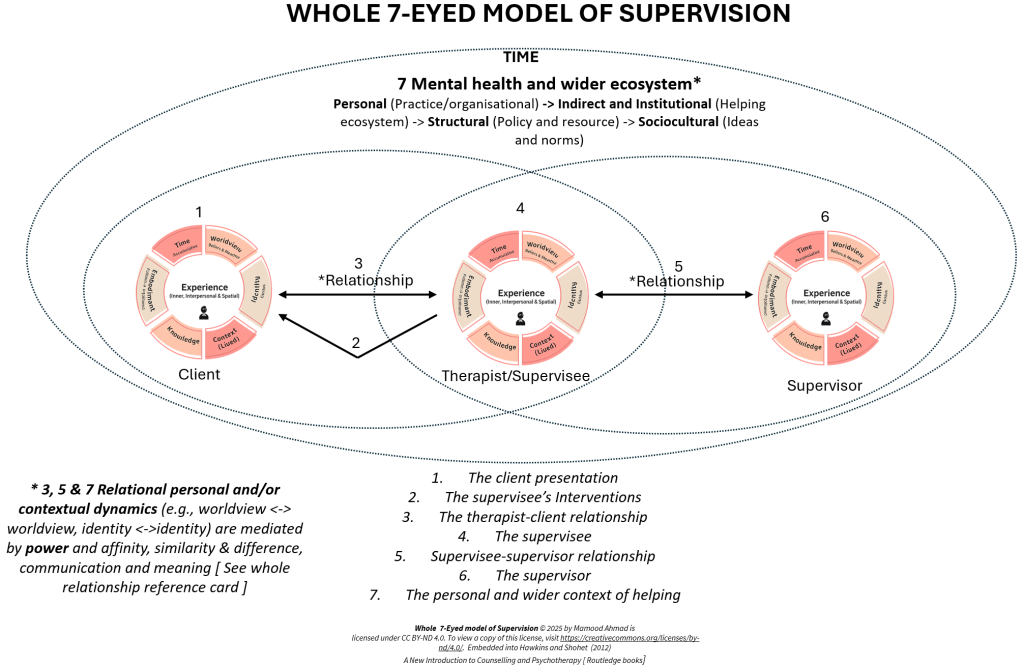
In doing so, supervision becomes not merely reflective, but ethically, culturally, and relationally accountable.
The revised Whole 7-Eyed Model is show below. For more information see book A New Introduction to Counselling and Psychotherapy or email newintro@tadf.co.uk


